Showing posts with label conceptual art. Show all posts

Sunday, April 3, 2011

Beneath the Canvas

Today's special blog post will be devoted to the exhibition of Zsuzsi Csiszér, a contemporary painter from Veszprém, which was recently opened in Várfok Gallery. The name of the exhibit, Journals, is an accurate summary of the atmosphere of the works presented, since most of them are the mementos of someone's daily musings and self-analysis in the mirror of the various impacts one encounters during the day. In that spirit, in her huge collages, Csiszér rips open the smooth canvas of reality, and scrutinizes the new associations and parallels between the fragments of tiny details and influences (ads, dreams, imaginary faces and landscapes) this reality is formed by. Using her brush as a scalpel, she drills small tunnels into the surface of things, and creates a new panorama to the chaotic mixture at the bottom of our, personal or collective, unconscious. Although her works are rather intrinsic, Csiszér manages to make a conversation with the outside world as well, because she addresses a number of external events in her pieces: she often uses bits of newspaper headlines and articles as a building material for her art for instance.

One of the artist's recurring motifs is the human face. Her large collages usually depict two or three faces from different angles, putting a great emphasis on the eyes, which have always carried the connotation of seeing the deeper essence of people or everyday phenomena. Still, some of these faces are painted with faint and nacreous colors, which sometimes create an artificial or kitsch-like effect. The paintings remain silent about the question whether this is a conscious and intentional thing from the artist's part, evoking the idealized images that mushroom in the media, or an inadvertent one. In this series, the pictures that portray aging people are way more interesting, since the fragmentary and deteriorating faces of old people resonate very well with the disintegratedness of the form itself.

Although the most impressive works are these collages, Csiszér also featured a number of witty and delicate installations made with different techniques. She grasps the subconscious of the typical female by displaying the same abstract and fractional elements on chopping boards for example. Also, the artist carved out a big papier macher figure solely from newspaper sheets, and made a miniature labyrinth out of tv program guides.
Still, one of the most intriguing objects in the gallery is probably an excerpt from the artist's actual journal, in which she ponders on her ars poetica and most inner feelings and thoughts; however, even here, her most intimate moments are stirred up by the menial happenings of daily life: one of her friends draws a small heart on her sheet of paper, or distracts her by talking to her about irrelevant issues.

Those who are interested in Csiszér Zsuzsi's above mentioned or other artworks can either check out her own blog: http://csiszerzsuzsicsiszer.blogspot.com/ or see the exhibition, which can be visited till 7th May.

Sunday, March 27, 2011

"But you didn't, did you?"

Hi all,

Today's blog entry will be devoted to two devious members of the YBA (Young British Artists): Tracey Emin, whose infamous work, My bed was already covered here, and Damien Hirst, the so-called leader of the group. Apart from discussing two pieces by each artist, I will touch upon the serious dilemma of creating remakes of certain works and the different positions these two artists take regarding this matter.


Tracey Emin - Everyone I Have Ever Slept With

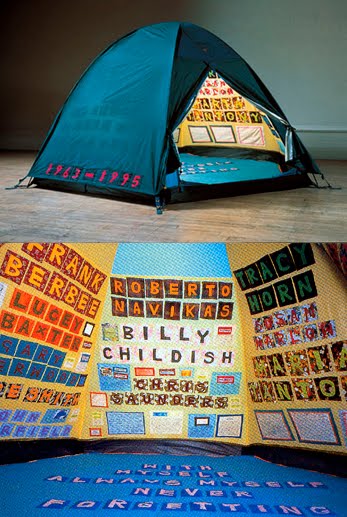
One of Emin's debuting works as a member of the YBA, Everyone I Have Ever Slept With, or The Tent, gained a fair amount of media attention when it was first exhibited in the Royal Academy in London, 1997. Basically, the young artist obtained a regular tent which she decorated with the names of literally everybody she has ever slept with between 1963 and 1995. This means exactly 102 names, which were appliquéd on the inside of the tent.

Unfortunately, the piece was usually misunderstood by the audience and critics as well, since they regarded the work as a symbol of Emin's promiscuous lifestyle. However, the artist emphasized several times that the majority of the names are the names of friends, relatives, school peers, and, staying true to her unusual ways of healing with the help of art, two foetuses whom she did not give birth to. Although Emin is generally not afraid of a saucy scandal, she stated that the misapprehension of this being the list of those she was sexually involved with reduces the message and meaning of her piece.

She wanted to create a work of art which is a memorandum of the intimacy and propinquity that those people experience who sleep together. "You don't do that with someone you don't love and don't care about" - she claimed. The tent carries another significant message to the artist herself, functioning as self-assurement and reinforcement at the same time: there is a text on its floor, which goes like this: "With myself, always myself, never forgetting"

Sadly, Emin's work was destructed in a fire at the East London Momart warehouse, which destroyed two of her other works, and a great number of other pieces by her fellow artists contributing to the Saatchi-collection. Apart from the loss of contemporary pieces of art, the event was increasingly upsetting, since the public's response was mockery and laughter, and "a lack of cultural understanding," as Emin later stated.

Although rumors say that she was offered tempting amounts of money to re-create her piece, she constantly refuses to do so, usually due to her highly emotional ars poetica: "I had the inclination and inspiration 10 years ago to make that, I don't have that inspiration and inclination now ... My work is very personal, which people know, so I can't create that emotion again — it's impossible."

Justify Full
Damien Hirst - The Physical Impossibility of Death in the Mind of Someone Living

This most renowned work of the leading member of the YBA was created in 1991, and was exhibited in 1992 for the first time. Basically, it consists of a dissected tiger shark preserved in a vitrine full of formaldehyde. Similarly to Emin's Tent, Hirst's piece gained great publicity and it is considered an iconic example of Britart; no wonder it was nominated for the Turner Prize.

The artist's primary intention was to shock his audience. He said that he wanted to embody his idea by something that is "big enough to eat you." That's how he found the shark, which was obtained and prepared for its life frozen to eternity by an excruciatingly lengthy and delicate procedure. Hirst achieved his goal, since his work is still frequently discussed and assessed in artistic arenas. In 2007, The New York Times took the effort to write an article which digs into the deeper meaning and context of the piece, and described it the following way:

"In keeping with the piece’s title, the shark is simultaneously life and death incarnate in a way you don’t quite grasp until you see it, suspended and silent, in its tank. It gives the innately demonic urge to live a demonic, deathlike form."

Yet, similarly to Emin's Tent, the piece was doomed to dissolution. In 2006, the original shark had to be replaced with a new specimen, and Hirst acted in a fully co-operative manner. Still, he had to face the philosophical and artistic dilemma whether the result was the same piece of art or not. Although Hirst was a bit hesitant, he stated that according to his background as a conceptual artist, he is entitled to think that the intention itself is more important than the original tools and specimen.

As for the harsh criticisms that claimed that anyone can create an artwork like this, the artist retorted: "But you didn't, did you?" I think, that's a fair argument in defense of a lot of contemporary pieces of art.

Tuesday, March 8, 2011

"If a Piece of Work Only Exists in your Head, Can it Still be Called Art?"

The next block in my blog will be devoted to two conceptual works of art: Yoko Ono's Play it by Trust and Zbigniew Libera's LEGO Concentration Camp. The two pieces were both created in 1966 and they touch upon serious issues in a playful and experimental way.


Yoko Ono: Play it by Trust

The observation of chess sets is a well-known phenomenon in artistic grounds. Duchamp even stated that they can be interpreted as the "landscape of the soul." However, most of these works which centered chess sets exploited the opportunities of different kind of decorations that can be applied in their case.

Contrarily to these trends, instead of coming up with a new decorative idea, Yoko ono made a fundamental and interior change regarding the function of a chess game. She extinguished all the black figures by painting them white. This way, she called attention to the fact that the world is not black and white. That is clear. But why didn't she give different colors to all the figures in order to symbolize diversity? It's because her concept was deeper and more abstract than the overused metaphor of a rainbow for highlighting distinctive features in people and the world.

In an interview, she claimed that everyone is different. We all know that by know. Everyone is unique and idiosyncratic in a way that is positive (individuality), and everyone can be different in a sense that is unusual or does not quite tie with the norm (equality movements, celebration of diversity, etc.) This differentness is something that is given and unchangeable. Ono said that it is the sameness that should be searched for because that is something that requires effort from people's part. Finding a similar platform, communicating and co-operating with each other is much harder than just tolerating or enduring each other. One of them is passive, the other one is active and constructive. That is why the competition element is taken out of the piece and is replaced by sameness and assimilation. Inspired by Zen philosophy, Ono emphasizes the necessity of self-discovery, and she extends this imperative to a collective level.

Although Yoko Ono works in the field of conceptual art, which means that the powerfulness of the idea itself is much more forceful and impressive than the manifestation of it, Play it by Trust cannot be judged as a completely alien and abstract piece of art which is only understood by its creator. The viewer can sit down, they are allowed to touch the figures, and they can try themselves out in the hard task Ono assigns to them.


Zbigniew Libera: LEGO Concentration Camp

Libera's work is undoubtedly a controversial piece of art since it deals with the sanctified topos of Holocaust in an appallingly colloquial manner. Holocaust is still a hot-button issue, and its depiction is still debatable, given that survivors always mention that no-one (not even the victims) can really disclose the excruciating horrors they lived through.

Libera used seven boxes of the popular game, LEGO to manifest his idea which was to build miniature concentration camps in their harshest reality (gas chambers, shooting soldiers, overworked and humiliated captives, and the like.) He was immediately threatened with a lawsuit by LEGO which was not familiar with the artist's purpose when they gave him the bricks for free. The general reception of the work was similarly scandalous. People - even artists - were outraged by the piece, claiming that it was not a work of art and it was the utter trivialization of one of the darkest events of human history. Still, a massive press campaign finally persuaded LEGO to drop the charges, and during the time that elapsed, the adjudication of the work grew more tolerant and lenient. Even the Jewish Museum in New York bought one of the replicas of the camp.

The LEGO Concentration Camp can be interpreted in many ways. First, it obviously calls attention to the practical presence of Foucault's biopower theory, which suggests that there is a technology of power which is a way of managing people as a group, reducing them to mere bodies which can be controlled. Thus, populations can be manipulated and regulated this way. In this specific case, Libera extends the concept of biopower to genocide, which is an organized form of the oppression and eradication of certain groups of people.

Another interpretation of the piece can be one in which we presume that Libera's camp is a fillip which criticizes the overprocessing of Holocaust in the media and in artistic spheres and thus trivializing and oversentimentalizing it. The LEGO figures can thus be symbols of the distorted and glamorized images that these other works convey regarding the Holocaust.
Viewed from another angle, Libera's piece can be regarded as a banalized and oversimplified game with the purpose of enabling people to cope with the tragedy easier.
From yet another viewpoint, which is a quite obvious one, LEGO Concentration Camp is just a symbol which stands for the brutality by which the Nazis treated other people just like figures in a child's game. Also, the fact that Libera made several replicas of the camp carries the dark message: history can repeat itself anytime.

It is certain that Libera's work of art carries a great shock value. Still, if the viewer is willing to overcome the general indignation, the piece will raise new questions regarding this clichéd topic which is still unutterably terrible, and which should not lose it's capability of provoking thoughts or emotions in people. Furthermore, a work like this is likely to provide new ways of finally overcoming and coping with the wounds.

Tuesday, March 1, 2011

Life Exposed

Hi all,

Today's post will be dedicated to the works of two artists, Tracey Emin and Ed Templeton, two artists whose art is strongly autobiographical. In fact, both Emin's and Templeton's pieces are so deeply rooted in their private sphere that they are sometimes more than bewildering. Both of these artist uses such things as love, depression, marriage, hobbies, sickness, and the like as raw material for their pieces. In a sense, they recycle little pieces of their lives as art. Thus, their oeuvre can be considered as a visual journal for their life story. The notoriousness of the result, even in contemporary art terms, is doubtless.

Tracey Emin - My Bed

Infamous for her perplexingly confessional sort of art, Emin created something with "My Bed" that really pushes the envelope. After living through suicidal depression due to relationship problems, she presented her rumpled bed, the visual journal of the rhapsodic emotional phases she went through, as a shockingly personal work of art. The bed is somewhat symbolic, yet, at the same time, it smells like real life to a rather intimidating extent.

The chaotic state of the bed represents the troubled frame of mind of the artist: the sheets are unwashed, there are visible blots of body secretions on them, also, there are clothes and seemingly innocent everyday objects in the bed and on the floor: a pair of bloodstained knickers, bottles of vodka, cigarette packs and fag butts, condoms, polaroids of self-portraits, a pair of slippers, and a fluffy peluche toy. Not only do these articles of despair symbolize an unbalanced mental state but they also give picture about the confusions inside the artist: the boundaries between the womanly and childish traits, as well as the dangerously adultlike objects (condom, alcohol) and the innocent ones (peluche toy) are not clear anymore. The polaroid self-portraits also indicate that the self-image was damaged and fragmented by the tensions she had in her life.

These exclusively personal objects extinguish the intimacy of the artist and they intrude in the intimacy of the audience as well. Everything is painfully sincere and straightforward about this work. It affects all the senses: the detriments and the litter in the bed not only have a visual impression on the viewer but they also suggest and evoke strong odors. The way the state of the bed is presented can be too much for the recipient. However, this abundance of mangy articles is in contrast with the absence of the root cause of the chaos. There's something that's missing here (the beloved man perhaps) whose objects would perhaps bring a balance and some reassurement to this derangement.

Taken as a whole, Emin's My Bed indicates an ars poetica of dirt and rawness which is somehow glorified by the latent emotions that lay under the rumpled surface. As Roberta Smith, an author of the NY Times wrote about the work: "it tells all, all the truths, both awful and wonderful, but mostly awful, about her life." The spontaenity and frankness of My Bed even brought Emin a nomination for the Turner Prize in 1999.


Ed Templeton - Map of the Inner War

Templeton's art, a colorful phenomenon in contemporary art, incorporates photography, digital art, painting, graphics, street art, videos, and sculpture as well. Being well known for his dedication towards professional skateboarding and skateborder lifestyle, the artist is extremely popular among the younger generation. He is particularly well-known for his idiosyncratic skateboard designs. As a public figure, Templeton supports vegetarianism, sport, healthy sexuality, and creativity among many other things.

His works' major characteristic is their openness and frankness. Templeton shows and tells the audience everything, even the things that the viewer wasn't really up for. He forces the recipients in the role of a voyeur: this oeuvre knows no taboos. His photographs give an unvarnished cross section of both his own private life and the crude reality of American people, especially the younger generation. On a personal level, he presents the tough everyday life of skaters: both the glory, the cheerful moments, and the injuries and failures as well. Also, he represents his wife, Deanna, as a totally humane and casual godess. He dares to go as far as exhibiting photographs of the two of them during sexual intercourse. Sexual liberty is a recurring motif in his collage-like images. On a broader level, he addresses current and topical problems of society. He takes sincere and deglorified pictures of the everyday street life of America: he shows the prostitution, poverty, neglect, obesity, the deviant behavior among youth, and the general lack of interest that is out there. The portrait he paints of America isn't a flattering one, however, he does not remain morose. There are several flashes of irony and humor in his photos.

The work that I've chosen from him is called The Map of Inner War, which was also a title of one of his exhibitions in the States. This painting carries significant attributes of his art: it resembles a collage, and the images and the inserted text reinforce each other.
Basically, The Map of Inner War reveals the frustrations of average people owing to the many expectations that society and mainstream social values force on them. On the left side of the painting, there is a little boy who is sitting at school, remaining silent while it is being hammered into his brain that Christianity is the only true religion. Although he has a different opinion ("This is bullshit") he doesn't give voice to his real thoughts. There's a small symbolic image hidden in this part as well: it depicts a washing machine while operating, and an arrow points at the things being washed: a short text says: "My brain."

At the bottom of the painting, there is a woman with a beautiful and voluptuous body, which symbolizes the distorting effect of the media's image of the ideal body on women.
Men's problems are also addressed: on the right side, there's an average middle aged man, who seems frustrated and worried because of his body. There are short texts and arrows which point out the general concerns of men: "pot belly", "receding hairline", "pathetically average penis."
On the top of the painting, there is a harsh contrast between the glamorous and noble connotations of the American flag and American symbols, however, in the background there's a route, a cemetery, and a road sign that says: END. This is not very unusual from Templeton: he often criticizes contemporary America and American utopia in his work.

Good news for Hungarian readers: Ed Templeton has a current exhibition in Budapest called The Cemetery of Reason. The setout can be visited in Ernst Múzeum (Nagymező street 8.) until March 20th.

map